How Le Mans rose from sixth tier to cusp of top-flight return
Le Mans is most commonly known for its 24-hour race, but the city's football club is backed by big-name sportsmen and on a rapid rise.
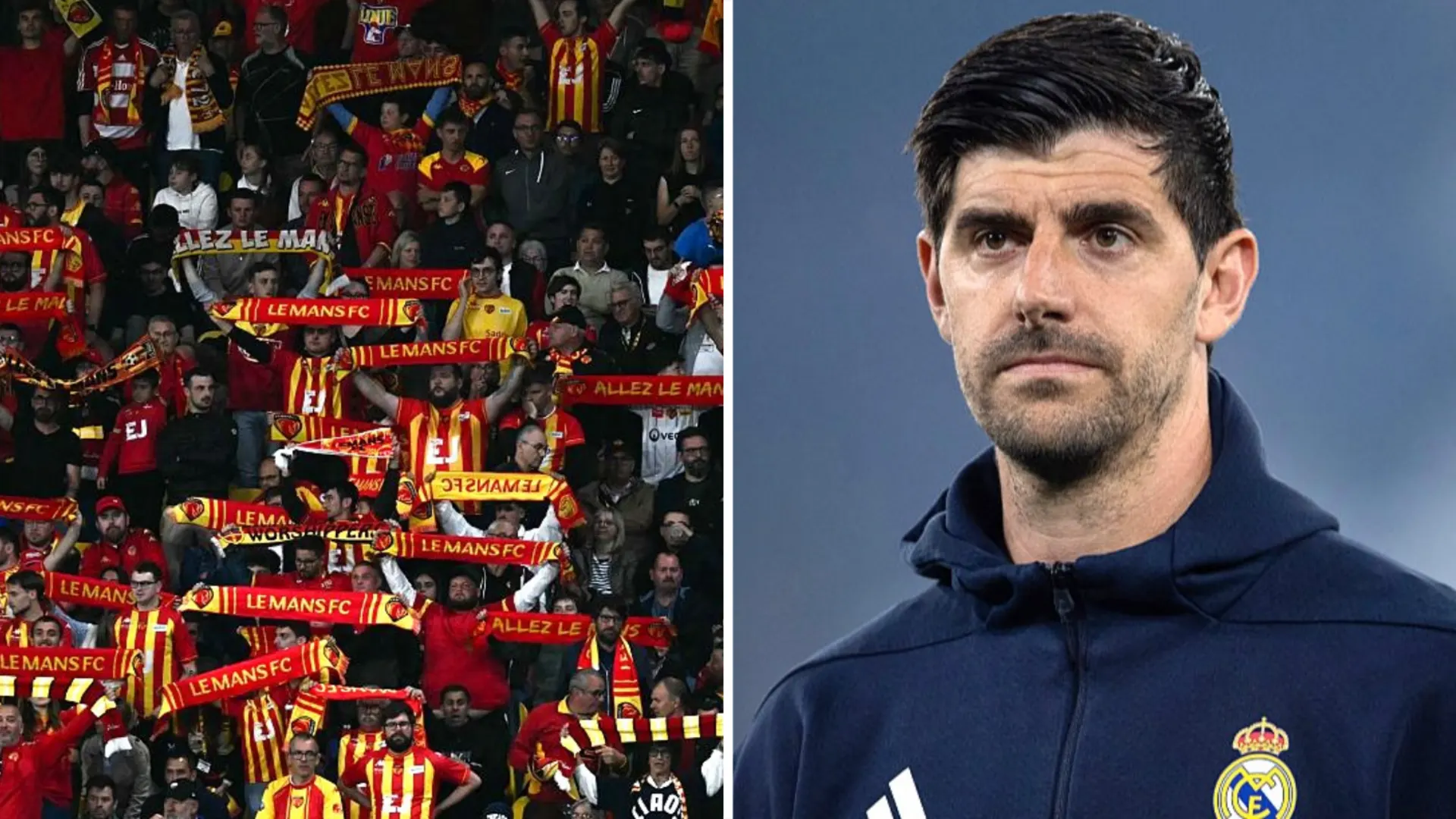
Thibaut Courtois is one of many sportspeople to invest in the French club
Words such as "speed" and "acceleration" permeate conversation about the French town of Le Mans - synonymous with the iconic 24-hour race that it hosts - but in this instance they reference its football club, now backed by big-name athletes and on a rapid rise.
It has been a long road back for Le Mans FC since they last featured in Ligue 1 in 2010.
Bankruptcy in 2013 meant they dropped to the sixth tier of French football. Last summer, the club returned to Ligue 2 while also welcoming new owners in the form of OutField.
The Brazilian investors brought Novak Djokovic, Felipe Massa and Kevin Magnussen with them. Real Madrid and Belgium goalkeeper Thibaut Courtois would later join the project.
"We wanted to bring really high-profile people that could help us leverage the project from a branding perspective," OutField co-founder Pedro Oliveira tells BBC Sport.
The link with Massa and Magnussen, both former Formula 1 drivers, is perhaps obvious given the town's motorsport heritage. The connection was also forged by a common contact, Georgios Frangulis, the founder and CEO of Oakberry, now an investor and operating partner at Le Mans.
Massa was already an investor in Frangulis' company, and also had a close connection to Magnussen. Frangulis is also the husband of Aryna Sabalenka, the world number one in women's tennis, hence the connection with Djokovic.
"[Frangulis] told us that Djokovic is crazy about football. We spoke to Djokovic, he liked the project, so he decided to invest," said Oliveira.
Courtois "really liked the whole idea of what [Le Mans] are building", and so he reached out to the investors and joined the project back in February.
"It is important that they know the world of sport because it is a world that has its own way of working," Le Mans president Thierry Gomez, who arrived in 2016 and is responsible for helping rebuild the club following bankruptcy, said.
Now, the club are on the brink of a return to the top flight - a win at Bastia on Saturday (19:00 BST) would confirm their promotion.
Le Mans' stadium sits inside the famous racetrack
At the time of OutField's arrival Le Mans were on a strong financial footing, despite the difficult economic context in French football and their own not-so-distant struggles.
That is in part due to Gomez's management of the club, but there was a perceived ceiling that only outside investment would help break.
"There was no urgency; the club didn't need help, but wanted to grow," Gomez added. "Rather than a question of survival, as it is for some, it was a question of finding someone else to take over."
Le Mans, who were in the third division when takeover talks began, were an attractive proposition for many reasons. A club without any debt, Oliveira also spoke of the "great infrastructure".
OutField took over Coritiba, a historic Brazilian side, back in 2023 and led them back to the first division. When looking to expand the 'portfolio' and move to Europe, Oliveira stressed a "focus on player development".
The investors looked at seven clubs in Portugal and five in France, Oliveira reveals, before honing in on the Paris region.
"The two main regions in terms of player development are the state of Sao Paulo in Brazil and the suburban area around Paris. Once we saw those numbers and some of the football projects in France, we decided to narrow our search to within 250 kilometres of the Paris area," says Oliveira.
That facet of the club will be built from ground zero. Le Mans' academy closed back in 2013 and Gomez says the idea is to reopen it in July. It will become the cornerstone of the project.
"Today, buying players, giving big wages, isn't on the roadmap. We'll see later, [if] we're in Ligue 1. It is when we are there that we would have to adapt," added the president.
The path trodden by Paris FC, taken over by the Arnault family, who topped Forbes' billionaire list back in 2024, won't be followed by the Loire-based club.
Gomez adds that player development is "a part of the club's DNA" and "an excellent tool" for the club.
"Developing our academy allows us to have players that we would otherwise not be able to access. Having a Kylian Mbappe at 24 or 25 isn't possible, [but] having tomorrow's Mbappe at 14, 15 or 16 at Le Mans is. That's why it is important for us," Gomez said.
Continue with Matchday Global
Source: BBC Sport European