The documentary that transformed a Welsh club into a global brand
What can you expect from the latest season of 'Welcome to Wrexham' and how has this documentary series transformed a football club in north Wales into a global phenomenon?
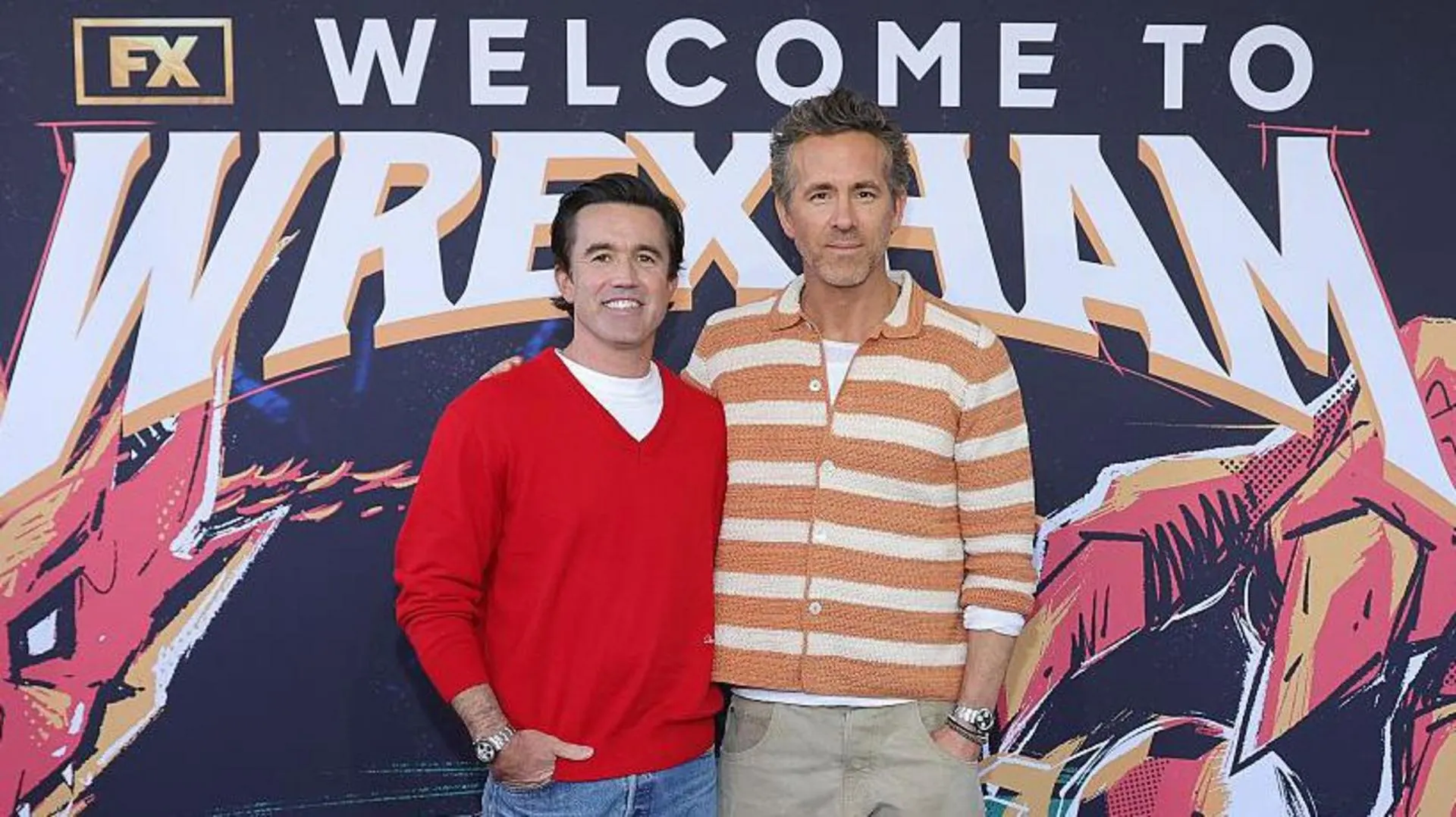
Co-chairmen and executive producers of 'Welcome to Wrexham' Rob Mac (left) and Ryan Reynolds (right) secured their takeover of Wrexham AFC in 2021
Spoiler warning: This article contains details of the first two episodes of the new series of 'Welcome to Wrexham'.
On paper, Welcome to Wrexham shouldn't work in the way that it has.
A documentary about a lower-league Welsh football club, far removed from the glamour of the Premier League, is hardly an obvious hit.
Yet the series has become one of the most compelling and captivating sports stories of recent years.
Season 5 premieres on Disney+ in the UK, and FX and Hulu in the US on Friday, 15 May.
BBC Sport has had an exclusive screening of what's to come in the early episodes before their public release.
So what can you expect, and how has this documentary series transformed a football club in north Wales into a global phenomenon?
When Hollywood duo Ryan Reynolds and Rob Mac completed their takeover of Wrexham, the idea that a documentary would follow felt almost inevitable.
The pair arrived with backgrounds in storytelling - Reynolds with an established reputation for marketing as much as acting, and Mac having spoken openly about how the Netflix documentary Sunderland 'Til I Die inspired his want to buy Wrexham.
Humphrey Ker, alongside the owners, is an executive producer on the series. He is also a director at the club, and was the man who introduced Mac to football.
"We always hoped that telling an authentic story about something as unique and yet universal as a football club would resonate... But I don't think any of us expected the level of interest" says Ker.
The involvement of Reynolds and Mac may explain the initial attention, but the reason audiences stay is different.
"It is the authenticity that keeps people coming back. People like Wayne Jones [owner of the Turf pub], Kerry Evans [the club's disability liaison officer], and Phil Parkinson [the manager] and staff are the real stars" says Ker.
That emphasis on community runs throughout. Rather than focusing solely on performance or tightly controlled narratives, it leans into the unpredictability of football and the lived experience of those around it.
"I think it's definitely the reason it works," adds Ker.
"Lots of sports docs present a polished and anodyne version of the 'product'… I think that veracity is what got people hooked."
For viewers, that authenticity translates into something more immersive.
The scale of that connection has even become the subject of academic research.
Professor Jan Boehmer from the University of Michigan is the co-author of the study 'Did Deadpool Save a City? The Socio-Economic Impact of Welcome to Wrexham'.
He believes the series allows audiences to feel personally connected to the town itself.
"Viewers quickly form a strong bond," explains Boehmer.
"They might feel as if they knew the people of Wrexham personally, making them part of the community… it doesn't feel like marketing. It feels like a good story."
That dynamic has helped the series travel beyond traditional football audiences.
While results still provide narrative tension, the emotional core lies within the social presence of the club.
Continue with Matchday Global
Source: BBC Sport Football