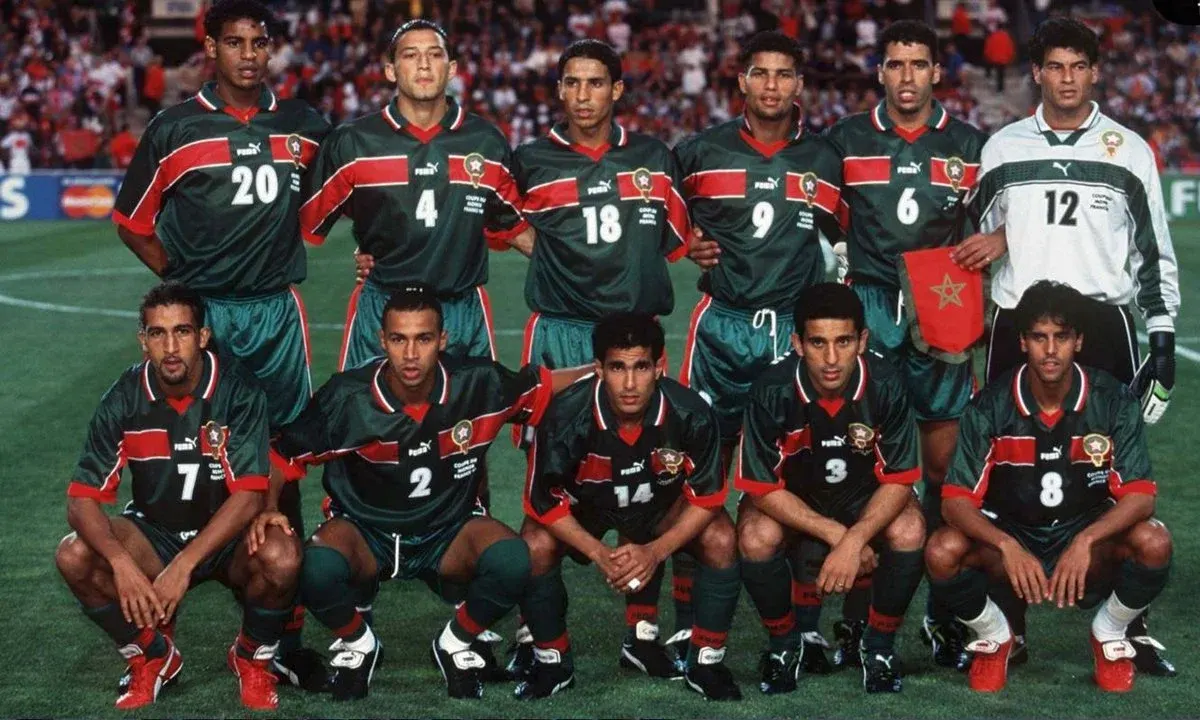
Throwback to the 1998 World Cup when Morocco, Brazil, and Scotland shared Group A: What changed?
With just four days to go before Morocco kick off their 2026 World Cup campaign in the United States, the tournament’s start comes nearly 28 years after the Atlas Lions faced Brazil and Scotland at the 1998 World Cup. At the 1998 World Cup in France, the three national teams were drawn together in Group […] The post Throwback to the 1998 World Cup when Morocco, Brazil, and Scotland shared Group A: What changed? appeared first on HESPRESS English - Morocco News.
With just four days to go before Morocco kick off their 2026 World Cup campaign in the United States, the tournament’s start comes nearly 28 years after the Atlas Lions faced Brazil and Scotland at the 1998 World Cup.
At the 1998 World Cup in France, the three national teams were drawn together in Group A, which FIFA said provided some of the tournament’s “most thrilling outcomes.”
Led by French coach Henri Michel, the Atlas Lions opened their campaign with a 2-2 draw against Norway.
On June 16, 1998, Morocco faced Brazil at Stade de la Beaujoire in Nantes, in front of more than 35,000 fans, but lost 3-0 to the South Americans.
A week later, on June 23, Morocco played against Scotland at Stade Geoffroy-Guichard in Saint-Étienne, securing a 3-0 win.
Former professional player Salaheddine Bassir scored twice in the 23rd and 85th minutes, while retired footballer Abdeljalil Hadda added the third early in the second half in the 46th minute, in front of more than 30,000 fans.
Morocco looked set to repeat their 1986 World Cup run and reach the Round of 16, but a late Norway goal against Brazil changed everything in the group.
The Atlas Lions finished third in Group A with four points, behind Brazil (6 points) and Norway (5 points), both of which advanced to the knockout stage, while Scotland ended with one point.
28 years later, Morocco, Brazil, and Scotland meet again at the 2026 World Cup, but the game has changed a lot since their last meeting.
Morocco’s national team is now ranked 7th in the world, even though they were 13th at the 1998 World Cup in France.
Back then, they had no major global accolades, and their main goal was simply to progress from the group stage.
Today, the Atlas Lions come into this year’s tournament as 2022 World Cup semi-finalists and 2025 Africa Cup of Nations champions.
Many football professionals see Morocco as well-placed to spring another surprise after they emerged as the main dark horse at the Qatar World Cup under former coach Walid Regragui.
For Brazil, the 1998 World Cup came at the peak of their dominance, but things have changed since then, with the South Americans struggling to win another World Cup title since 2002 in Korea/Japan.
In their last World Cup appearance in 2022, they were knocked out in the quarter-finals by Croatia after a 1-1 draw, losing on penalties, and went home before the Atlas Lions.
This has led to a growing disconnect between Brazilians and the national team, with data from the research institute Datafolha showing that 54% of Brazilians currently have no interest in the national team, compared to just 20% in 1994.
Still, CNN names Brazil among the World Cup favorites but notes they arrive in unusual circumstances after finishing fifth in South American qualifying.
Since Qatar 2022, the news outlet noted that the team has gone through four coaches before the appointment of Carlo Ancelotti, the first foreign manager in its history.
For Scotland, their FIFA ranking in 1998 was between 41st and 36th, somewhat close to their current position of 42nd.
They return to the World Cup in 2026 after a 28-year absence, as their last appearance came in 1998.
The team went through a long decline before rebuilding into a high-quality and well-organized side, according to FIFA.
Continue with Matchday Global
Source: Hespress
More stories

2026 World Cup Odds: Which Player Will Lead the Tournament in Assists?

How The Smallest World Cup Nation Recruited Its Team

Anan Khalaili’s Champions League performances analysed as Newcastle eye move