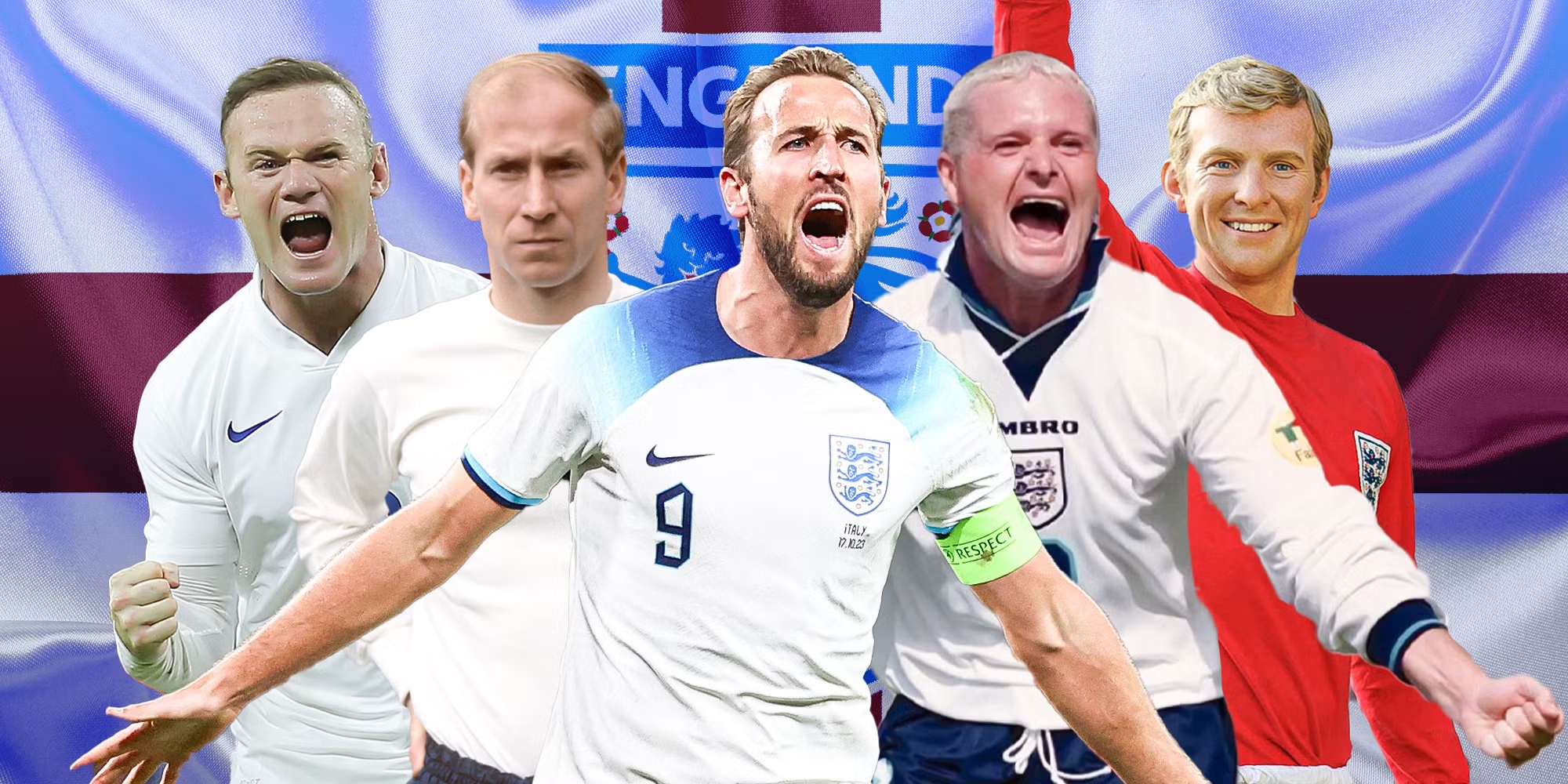
25 Best English Footballers of All Time (Ranked)
The greatest players that England has produced down the years - ranked in order.
Callum has a degree in football journalism, having graduated from the University of Derby in 2024 and he haswritten for a variety of sites in the past, including news and listicles for 90min, features for The Sportster and listicles for Sportskeeda.
He got his start with GiveMeSport through their academy in the summer of 2023 and was offered a freelance position shortly afterwards, before transitioning into a full-time role.
Callum produces news articles and features on a variety of sports, including basketball and professional wrestling, but has written about MMA and football in the past. He is a big fan of both Blackburn Rovers and the Orlando Magic and loves watching WWE, AEW and UFC. Sign in to your GiveMeSport account Summary
Members from the 1966 World Cup winning squad feature, including legends Bobby Moore and Sir Bobby Charlton.
Modern-day stars like Harry Kane and Wayne Rooney also feature highly.
Ranking factors include success at club and international level and longevity.
England have produced a whole host of wonderfully talented footballers over the years. While the Three Lions have only won a major international tournament once - the World Cup in 1966, as they beat West Germany 4-2 on home soil - there have been countless incredible footballers to have graced the famous Wembley turf.
Wayne Rooney topped the voting as he was crowned the greatest footballer to play for England in the eyes of fans. However, there will be other supporters who strongly feel that Sir Bobby Charlton or Sir Bobby Moore deserve that title, given the fact they were key figures in the nation's triumph at the World Cup, six centuries ago.
We've crunched the numbers and ranked the top 20 best English players ever, which includes members of the country's poorly-executed 'Golden Generation' as well as a few names of England's World Cup win - including hat-trick hero Sir Geoff Hurst and aforementioned skipper Moore. But, using the ranking factors below, who else makes the cut?
One of the very few figures in Three Lions mythology to have represented the nation on both sides of the white line is Glenn Hoddle, who earned a reputation for being among the most gifted footballers of his generation while turning out for the likes of Tottenham Hotspur and Chelsea. His AS Monaco stint is also one for the ages.
A force to be reckoned with, Hoddle - a 53-cap England international between 1979 and 1988 - made it look as if the ball was stuck to his feet with glue and dispossessing the Spurs hero was, at the worst of times, near impossible. Internationally, the attacking midfielder-turned-boss was crucial throughout the eighties under Bobby Robson's reign.
A late bloomer of sorts, Ian Wright - whose non-league cult hero to Premier League legend trajectory is the stuff of legend - had all manner of finishes in his locker: he could latch onto crosses, be the first man to a loose ball in the six-yard box or curl one in from outside the box. His goals side, his striking mastery was second to none.
In Arsenal's greatest XI of all time, there was no room for the likes of Cesc Fabregas nor Robert Pires.
He and Terry Venables were not on the same wavelength, admittedly, which led to the striker not getting the international recognition he so thoroughly deserved. With just 33 caps and nine England goals under his belt, there's a compelling case to be made that his appearance numbers should be pushing the 100s.
Captain Marvel to many, they simply don't make characters - or footballers, for that matter - like Bryan Robson anymore. He was a burly midfielder who dotted about the engine room with ease, and won all manner of silverware with Manchester United across his career, including two Premier League titles.
Robson, a reliable figure under Sir Alex Ferguson, once scored the fastest goal - at that time - in World Cup history when he hit the back of the net after 27 seconds against France in 1982. Sustaining a series of career-threatening injuries, however, caused issues from start to finish for the all-action ace. On the international stage, Robson chalked up an eye-catching 90 appearances.
With 40 goals for his country, Michael Owen is the sixth top scorer in English football history. The former Liverpool and Manchester United striker played in five tournaments, scoring in four of them. He is most famous for his goal against Argentina in the 1998 World Cup, which remains one of the most memorable goals for the Three Lions in a major tournament.
He was also extremely successful at domestic level, winning the Premier League, FA Cup and UEFA Cup. In 2001, he won the Ballon d'Or after winning three trophies for Liverpool in the same season. Owen remains the youngest scorer for England at a World Cup with his goal against Romania on 22nd June 1998. He was just 18 years and 190 days old at the time of the goal.
After serving in the Second World War, Sir Tom Finney turned his attention back to what he loved, and that was playing football. A legend among Preston North End circles after spending the entirety of his club career with the Lancashire club - but he also earned legendary status on the international stage after 77 caps and 30 goals.
According to legend, Preston-born Finney was doubtlessly one of the best footballers of his generation and capable of playing anywhere across the frontline: on either wing or through the middle. Voted Football of the Year on two occasions - in 1953/54 and 1956/57 - Finney was utterly selfless when on the pitch, a sentiment echoed by Preston teammate Bill Shankly. He called him "the greatest player I ever saw, bar none."
No one has played more games for England than this man, Peter Shilton. As such, he's done more than enough to earn a spot on this list of the Three Lions' all-time greatest players. The former Leicester City man played 125 times for his country, and his time with England spanned the course of two decades, with his first appearance coming in 1970, and his last in 1990.
Having been inducted into the England Hall of Fame back in 2002, Shilton's excellent legacy with the international team can't be overstated. No one could usurp him in between the sticks at major tournaments with England for quite some time - and that's just a testament to his shot-stopping brilliance.
It's no secret that Rio Ferdinand, an undeniable icon in the Old Trafford echo chamber, enjoyed a career steeped in silverware and memorable moments. His six Premier League titles between 2002/03 and 2012/13 proved that he was a brilliant defender, leader and footballer around the turn of the century.
Any sort of trophy evaded the central defender on the international stage, of course, but he was still a reliable figure for his country over the years. Brother to Anton and second cousin of Les, Rio became the world football's most expensive defender on two occasions, and he picked up 81 caps for England between 1997 and 2011. For club and country, you could always rely on the defender-turned-pundit.
Another member of Sir Alf Ramsay's World Cup-winning side of 1966, the aforementioned Hurst is a name that will forever remain in England mythology by virtue of the fact that he bagged three goals in his side's 4-2 victory - but, incredibly, he wouldn't have necessarily played as Jimmy Greaves' absence allowed him to start.
Continue with Matchday Global
Source: GiveMeSport
More stories
Every 26/27 Premier League Club's First 5 Games Ranked By Difficulty
Mourinho’s Personal Call Sealed Cucurella’s £52m Real Madrid Move
Teti identified as Milan’s latest option for sporting director
