EXCLUSIVE: Super Eagles Goalkeepers Through The Ages — From Okala’s Dominance To Nwabali’s Modern Pressure
Being a Super Eagles goalkeeper comes with a tremendous weight of responsibility. In Nigerian football, the emotional weight and sentiment attached to goalkeeping are almost ten times more than any other outfield position. It may appear that other positions dominate conversations, but Super Eagles fans never overlook their goalkeepers. Goalkeeping is one role where excellence [...] The post EXCLUSIVE: Super Eagles Goalkeepers Through The Ages — From Okala’s Dominance To Nwabali’s Modern Pressure appeared first on Complete Sports.
Being a Super Eagles goalkeeper comes with a tremendous weight of responsibility. In Nigerian football, the emotional weight and sentiment attached to goalkeeping are almost ten times more than any other outfield position. It may appear that other positions dominate conversations, but Super Eagles fans never overlook their goalkeepers. Goalkeeping is one role where excellence is often expected but rarely forgiven when absent.
A striker, for instance, may miss chances and still be celebrated for something else, say, work rate. Victor Osimhen had finishing woes at the 2023 Africa Cup of Nations but his contributions were valued elsewhere in the team’s collective success. A defender also can be part of a collective collapse and still escape full blame. Just imagine if the goalkeepers had bad days.
Goalkeepers stand alone, and in that isolation, every decision they make becomes magnified, whether good or bad. They live in permanent exposure, where one bad decision can survive in public memory longer than a dozen brilliant saves they made. Across decades, Nigeria has produced goalkeepers who influenced the average Nigerian’s belief about the role.
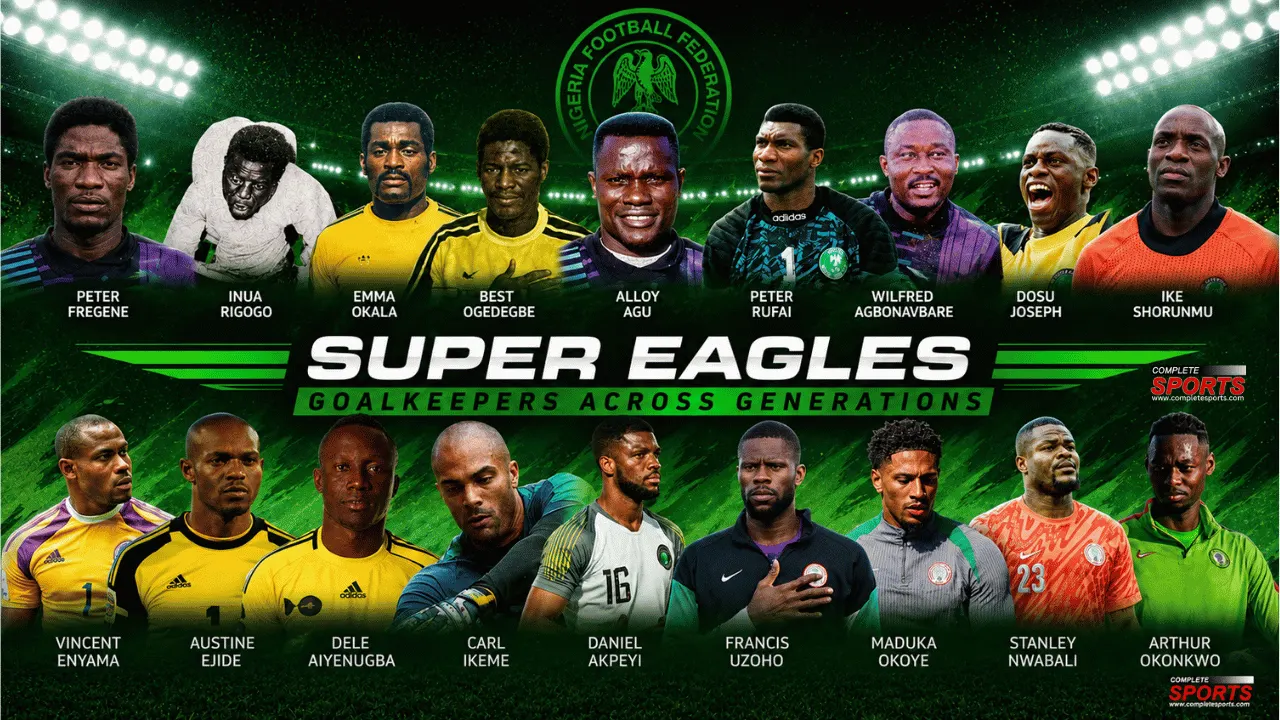
Almost every Nigerian today had that goalkeeping figure who was prominent in their childhood, teenage or early adult years. The older generations often talk of Okala, Ogedegbe, and Fregene among those who dominated their era or championed transition.
Millennials may be fond of Rufai, Shorunmu, Dosu, Enyeama and even Austin Ejide or their peers, while Gen Zs and Alphas might favour Nwabali, Okoye, Uzoho, Ikeme, Akpeyi, or any of the modern names today. In some way, they may even remember Vincent Enyeama, especially if you consider the part where they might have witnessed Enyeama captain the Super Eagles to a third AFCON title in 2013.
Also Read: EXCLUSIVE: Analysing Owen Oseni, Femi Azeez Ahead Possible Super Eagles Debuts At Unity Cup 2026
The story of Nigerian goalkeepers points to how the country itself has evolved in football consciousness. In many ways, Nigeria’s entire footballing history can be told just by looking through the goalkeeping eras and that is exactly what we are going to do.
In this piece, Completesports.com’s ALLI FESOMADE traces the long history of Nigerian goalkeepers across the different eras. Today, we are following the men who stood as the last line of defence while carrying the trust and expectations of an entire nation.
Before Nigerian football became globally recognised, figures such as Peter Fregene represented that foundation in the Green Eagles. Fregene’s career stretched almost three decades. Peter Fregene first gained prominence in the 1960s with ECN FC and earned national attention at the 1968 Olympic Games. His performance against Brazil at the tournament remains one of the earliest international reference points for Nigerian goalkeeping credibility.
Alongside him were other early figures like Inua Lawal Rigogo, remembered for his flamboyant style and acrobatic presence. These men played in an era where documentation was limited, but stories of Inua’s confidence and unpredictability became part of Nigerian football folklore, passed down through generations of Super Eagles supporters.
The 70s and 80s were an era of Nigerian football that the older generation often speak of with a rugged, almost mythic energy and nobody dominated conversations better than Emmanuel Okala and Best Ogedegbe.
In those days, six-foot-six Emmanuel Okala was a terrifying figure. They called him ‘The Man Mountain’. Emmanuel Okala’s frame filled the goalmouth and opposing players were met with such intimidation every time they approached the Green Eagles’ goal.
Whether for Enugu Rangers or the national team, Okala represented intimidation in its purest form. The older generation still describes him less like a footballer and more like a force of nature. Segun Odegbami, in particular, spoke of Okala in their local duels during his days at IICC Shooting Stars. Okala also had good command of the Nigerian defence and created the impression that he was a leading voice in the team whenever he was present.
Nigeria in the 1970s did not yet possess the polished international identity that later generations enjoyed, so goalkeepers of that era survived largely on raw authority, physical courage, and personality. Okala and Ogedegbe represented all three, becoming one of the earliest figures to convince Nigerians that the country could consistently produce elite shot-stoppers rather than occasional talents.
The Super Eagles started the 80s with the AFCON success on home soil, and Best Ogedegbe became the calm face of a landmark achievement. Ogedegbe’s role in Nigeria’s 1980 Africa Cup of Nations triumph altered how the country saw itself in African football. He wasn’t initially the obvious first choice but seized the opportunity during the tournament and became a key figure in Nigeria’s first continental title win.
Also Read: EXCLUSIVE: Why Michael Kayode’s Premier League Rise Is Intensifying Super Eagles Pursuit
Goalkeepers often inherit the personality of their era and both Okala and Ogedegbe suited a generation that valued discipline and maturity, among other qualities. You can verify this if you just consider the values of older generations who often speak of them. These qualities also mattered because of the sharp emotional radar the nation has for football. That Green Eagles side of that era attacked with confidence because they trusted the men behind them.
The years that followed produced quality but not the desired continuity. Alloy Agu emerged as a reliable presence, contributing significantly to the national team during the early 1990s and later returning in a coaching capacity. Looking holistically at the Nineties, this was the decade when the Super Eagles became globally recognisable and Peter Rufai stood at the centre of that golden generation.
Rufai became one of the key figures during the 1994 FIFA World Cup. That World Cup remains one of the greatest emotional experiences in Nigerian football history, and Rufai’s role in it was enormous. Nigeria topped a group containing Argentina, Bulgaria, and Greece, playing with the kind of confidence that gave the impression that the country was capable of defeating anybody. Even the heartbreaking defeat against Roberto Baggio’s Italy carried a peculiar sense of pride because Nigeria had become globally competitive.
Peter Rufai had this calm aura but was commanding in his own way. He provided balance in a team known for attacking brilliance and brought structure to a period of transition. His nickname “Dodo Mayana” came from a language pronunciation shakeup when fans watched the team train and wondered when next Rufai was going to play. For many millennials who watched him play, he remains one of the most dependable goalkeepers the country has produced.
That era also produced Wilfred Agbonavbare, whose story travelled beyond Nigeria into Spanish football culture. That decade, Wilfred also built a strong reputation as a goalkeeper, particularly in Spain with Rayo Vallecano, where he was admired for both his ability and his personality.
Joseph Dosu’s rise during the Atlanta 1996 Olympic Games added another dimension. His performances suggested long-term potential at the international level, but a career-ending injury shortly after the tournament cut that trajectory short. The transition from this was a period filled with capable professionals but also growing instability.
One key mention from this era is also Ike Shorunmu. Shorunmu was a reliable and long-serving Super Eagles goalkeeper and later became a goalkeeping coach for the national team. Shorunmu was widely respected for his reputation and technical understanding of the role. Between 1992 and 2002, he won two bronze medals across three Africa Cup of Nations tournaments but never lifted the trophy as a player.
He was Nigeria’s first-choice goalkeeper at the 2002 World Cup, where he delivered a strong performance against Argentina despite the Super Eagles’ early exit. His career is also impacted by near-misses at the 1994 and 1998 World Cups due to selection and injury setbacks.
After retirement, Ike Shorunmu moved into coaching and became part of the technical crew that guided Nigeria to the 2013 AFCON title, finally lifting the trophy as an official. Ironically, that same 2002 tournament also marked the beginning of Vincent Enyeama’s rise, after the young goalkeeper was handed the final group game against England ahead of him. But in another twist of football history, 11 years later, Shorunmu now found himself helping coach Enyeama to an Afcon title, the same man whose defining national team breakthrough began as his own World Cup chapter was winding down.
Continue with Matchday Global
Source: Complete Sports
More stories

'You make us laugh more than Barca!' - Atleti mock Real after £129m Alvarez bid
Segunda play-offs decided as Mirandes become final side to be relegated
Atletico reject Juventus Sorloth bid as Bianconeri enquire for Arsenal & Chelsea duo Jesus and Jackson