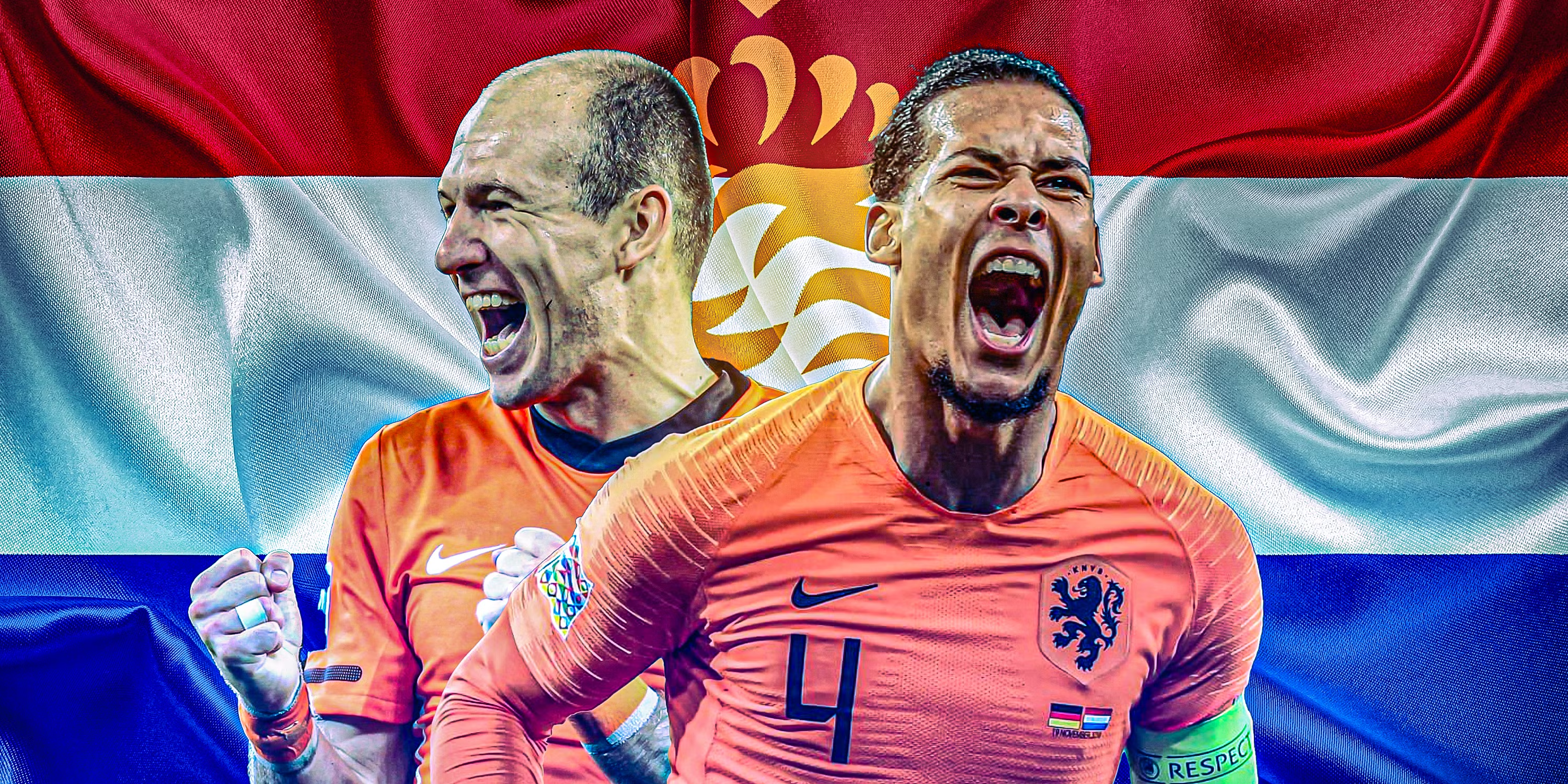
Why The Netherlands Play in Orange
The Orange kit has been made famous by the Netherlands, but why?
Kit colours hold profound significance for national teams, extending beyond mere aesthetics to embody the identity, heritage, and unity of a nation. These colors are not arbitrarily chosen; they often reflect historical events, cultural symbols, or national values, serving as a powerful visual representation of a country’s story.
At any major tournament, one of the most striking kits on display will always be that of the Netherlands' orange home strip. Whilst many teams don kits featuring colours taken directly from their flag, like England's white and red or the blue of France, the Dutch choice stands out vividly, with its bold, bright hue not just an eye-catching feature of the aptly named 'The Oranje', but also serving as a reminder of exalted football nobility.
It is associated with some of the most iconic moments and figures in football folklore, with the Dutch teams of the 1970s, led by Johan Cruyff, revolutionising the sport with their "Total Football" philosophy, gaining international acclaim and leaving a lasting legacy on the beautiful game.
Yet, not many people, football fans or not, have any idea why the Netherlands choose to play in orange when the colour isn't represented in their flag. So GIVEMESPORT has put the onus on themselves to explain why.
From England’s epic 90s classics to Celtic’s simple-but-effective Lisbon Lions' masterpiece, here’s a ranking of the most iconic British kits.
The main reason the Netherlands play in orange is that it serves as a tribute to the House of Orange-Nassau, the royal family of the Netherlands, whose lineage began with William of Orange, a pivotal figure in Dutch history.
Also known as William the Silent (not because he said little but because he did not reveal his thoughts), he led the Dutch Revolt against Spanish rule in the late 16th century, paving the way for the independence of the Dutch Republic. His legacy is celebrated in various aspects of Dutch life, and the national football team's orange shirts are a vibrant symbol of national pride and unity. The color orange has since become a national color, adorning everything from sports kits to celebrations on King's Day, a major national holiday.
This historical connection infuses the football kit with a rich sense of heritage and identity. With their nickname also being 'Oranje', the significance stretches far and wide, and they've, at times, been coined 'Clockwork Orange' in the media, often when they are playing their best, most rhythmic football.
Including the likes of Johan Cruyff, Marco van Basten and Arjen Robben, the best Netherlands players of all time have been ranked.
However, it isn't just in football where the orange is represented in the Netherlands. They also took on the nickname of the 'Orange Army' in Formula One as they support their number one driver and four-time World Champion Max Verstappen. Although the Dutch flag has three colours, none of them are orange. Instead, at the top, you'll find red, which symbolises bravery. Then, there is white, which represents peace and honesty. Finally, you'll see blue at the bottom, which means truth and justice.
The orange strip has also been associated with some of the most iconic moments and figures in football. While Real Madrid's famous white and gold kit is immediately linked with glory, Barcelona's Blaugrana shirts are synonymous with Catalan footballing resurgence and Lionel Messi, The Netherlands' 'Oranje' uniform serves also as a reminder of the 1970s and the principles of total football.
During that period, Dutch teams like Rinus Michels' Ajax pioneered tactical innovations. Fundamentally changing the way football was played, the 'Total Football' system emphasised fluidity, versatility, and players' ability to interchange positions seamlessly during a game for the best outcome at the end.
It made a starring appearance when Ajax lifted the European Cup three years on the trot from 1971 to 1973, while The Netherlands would be runners-up in the 1974 World Cup, and those who played under this imaginative umbrella would be likened to those of "artists, writers, even ballerinas".
Ever since the 70s, successful coaches like Pep Guardiola have taken on the ideals and tweaked them for his own teams to create bastions of invincibility in the form of Barcelona, Bayern Munich, and, most recently, Manchester City. This proves how influential the Dutch were in moulding today's beautiful game, and through the orange kit, memories of that period attain an everlasting status within the sport. Players such as Marco Van Basten, Ruud Gullit, among many others, have also helped keep the orange shirt famous.
Brazil's famous yellow kits are remembered throughout the world, being deeply associated with the country's footballing prowess.
Wherever the Dutch national team plays, you'll usually spot a sea of orange filling the stands, with supporters embracing the color just as passionately as the players themselves. It has become one of the most recognisable sights in international football, with entire sections of stadiums transformed into a wall of bright orange shirts, hats and flags whenever the Netherlands take to the pitch.
That same sense of fun and identity extends to the famous 'Links Rechts' song, Snollebollekes. English-speaking fans probably know it better as "the Left Right Song", which is now one of their main adopted songs. Its catchy and repetitive nature has made it a pre-match ritual for the thousands of fans that line the streets, regularly going viral online during tournaments. Together, the color and the chant have helped create a matchday atmosphere that is instantly associated with Dutch football, regardless of how the team itself performs on the day.
Continue with Matchday Global
Source: GiveMeSport
More stories

Premier League fixtures: Arsenal open against Coventry, Liverpool at Newcastle

Mourinho’s Personal Call Sealed Cucurella’s £52m Real Madrid Move
Juventus reopen Kolo Muani talks as Carnevali searches for a Vlahovic replacement
