World Cup Hydration Breaks Explained
FIFA has introduced mandatory 'hydration breaks' - a period for players to have a drink of water - at the World Cup, but why are they controversial?
His work has been published in the London Magazine, Last Word On Sports, Star & Crescent, and Hello Student, as well as his award-winning online publication Vendor, which he solely founded in 2016.
Outside of GIVEMESPORT, Jordan works part-time and in freelance roles in social research and education. He is currently a Visiting Lecturer in Media, Journalism, and Communications at the Polytechnic University of the Philippines, the country's largest state university. He previously lectured in Creative Writing at the University of Portsmouth.
Jordan follows a wide range of sports, but his passions lie in professional wrestling, football, F1, and middle and long-distance running. Sign in to your GiveMeSport account They have become a familiar sight, and for some fans and players, an unwelcome one. The 2026 World Cup hydration breaks have quickly become one of the tournament's biggest and most controversial talking points.
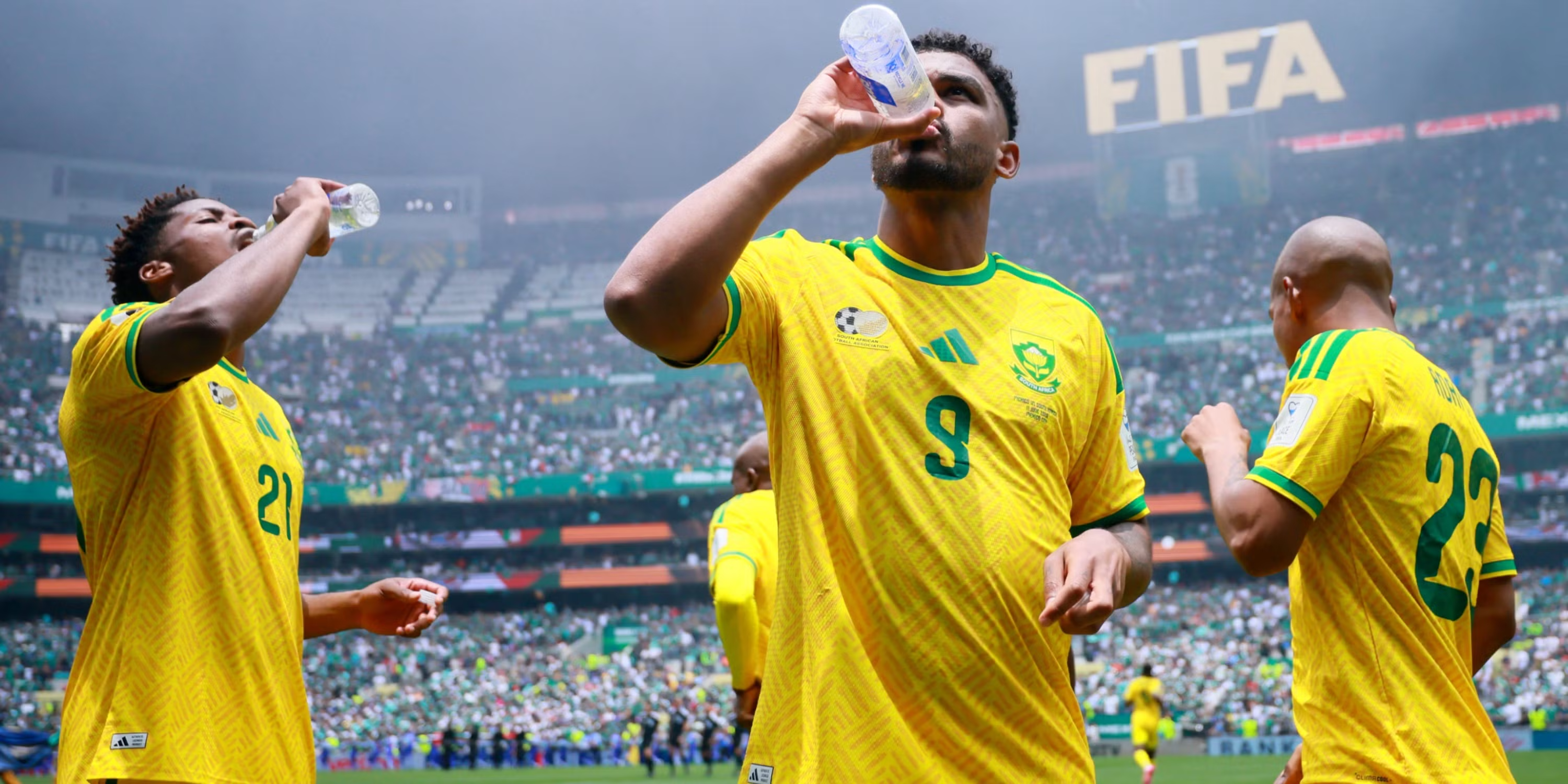
With the World Cup taking place across the USA, Canada, and Mexico, FIFA have imposed mandatory hydration breaks around the 22 and 67-minute marks of every match to counter the hot weather conditions of the host nations.
But the source of controversy is the consistency of these hydration breaks, regardless of whether conditions are difficult or bearable. This has been a source of discussion among many players, fans, journalists, and pundits.
American sports fans will be used to this type of segmentation, with World Cup matches being essentially divided into four quarters. For many, football matches in the tournament now mirror the structure of an NFL or NBA game.
But whether you view them as necessary or just an excuse for a commercial break, here is a rundown of how the World Cup hydration breaks came to be, how they're being received, and whether they have a lifespan beyond the tournament.
FIFA first announced their plans for hydration breaks at the World Cup last December. The move was a direct response to the conditions experienced at the FIFA Club World Cup, which was hosted by the United States in the summer of 2025.
The severe heat experienced by many of the participating players was highlighted as a concern ahead of this year's World Cup, prompting FIFA to deliver a more structured approach to the hydration breaks.
The hydration breaks are three minutes long and have been added to provide a "streamlined and simplified" improvement to the less structured implementation at previous tournaments. The breaks will be imposed in all matches, regardless of the current weather conditions. This is also the case for matches that are being contested in stadiums with air conditioning and roofs.
FIFA have reiterated that the hydration breaks are the result of learning from experiences at past tournaments, and are supposedly "part of a focused attempt to ensure the best possible conditions for players."
But the stated motive behind the breaks hasn't convinced a cohort of the travelling England fans. A clip shared by the BBC showed the extent of the frustration felt by the fans supporting Thomas Tuchel's side at the 2026 World Cup.
"It is an air-conditioned stadium. You do not need a hydration break," declared one England fan in the video. "It's the Americanisation of football," added another. Even one American fan thought that the hydration breaks were questionable. "It just feels like an extra addition. A money grab."
However, one England supporter was a bit more diplomatic. "In this stadium, I don't think they were needed. But in a stadium where there's no overhead cover, there's no air con, and you're playing in 90F plus, they're absolutely essential."
The former Champions League and Premier League winner has given his blunt opinion once more.
For American fans, this type of interruption is part and parcel of their regular sports programming. But it doesn't make it an easier pill to swallow. And as for players and coaches, it can have a significant effect depending on the landscape of the game when that hydration break is called.
And there have already been some notable beneficiaries and victims of the hydration breaks in the tournament so far. Curacao were left wondering "what if", following their unlikely equaliser against Germany just one minute before the first-half hydration break. The stoppage allowed Germany to regroup before they went on to score another six goals and secure victory.
The Netherlands were in a similar situation in their group stage opener against Japan. The euphoria of Crysencio Summerville's 64th-minute strike was dulled by the second-half hydration break. When play resumed, their momentum waned before sinking to an 89th-minute equaliser.
Netherlands and Liverpool captain Virgil van Dijk, whilst balanced in his appraisal, revealed that he wasn't a fan of hydration breaks. "Hydration breaks are a bit interesting, because I was obviously watching almost all the games up until today, and every time going to commercial is a bit [...] Not really that I like it," he said. "I think for the neutral watchers on TV it's also not great.
"If it's really hot, obviously it would be good to put them in. But I think you have to look at it in every game, separately, in my opinion."
Mauricio Pocchettino, coach of the United States, one of the host nations, was similarly critical. "I don't like it. I only like it when the conditions are extreme.
"But when the conditions are good, it is unnecessary."
Whilst discussion of financial injections continues to dominate the discussion around hydration breaks, the likes of Virgil van Dijk, Mauricio Pochettino, and even some fans, recognise that they do play an important role in player safety when necessary.
It begs the question: is the World Cup merely a test for a global rollout of the hydration break in football?
In hotter climates, it could be welcomed overwhelmingly. Spain manager Luis de la Fuente was supportive of the hydration breaks ahead of his team's opener against Cape Verde. "I am always interested in the health of my players. I think it's the right measure, a pause, freshen up and continue." Tactical or otherwise, de la Fuente's opinion may be influenced by the consistently higher temperatures in his native Spain.
Continue with Matchday Global
Source: GiveMeSport
More stories

Premier League fixtures: Arsenal open against Coventry, Liverpool at Newcastle
Mourinho’s Personal Call Sealed Cucurella’s £52m Real Madrid Move

Juventus reopen Kolo Muani talks as Carnevali searches for a Vlahovic replacement